Sezione Studi su Rennes-le-Château Analysis of alignments in R-Environment - Alignments on pentacles
Two points define four different pentacles. Given the coordinates of the first two points (A1,A2) and (B1,B2), with a simple mathematical formula it is possible to find the coordinates of the three other vertices in the pentacles. Let's fix the first two points A(10,10) and B(40,50): A1 <- 10 The other points can be calculated with these formulas: C1<-(B1-A1)*((sqrt(5)-1)/4)+(B2-A2)*sqrt(sqrt(5)/8+5/8)+B1 The five points should be stored in an array: x1 <- c(A1,C1,E1,B1,D1) A second pentacle can be found with a second formula: C1<-(A1-B1)*((sqrt(5)-1)/4)+(A2-B2)*sqrt(sqrt(5)/8+5/8)+A1 The five points should be again stored in a second array: x2 <- c(B1,C1,E1,A1,D1) The third and fourth pentacles can be calcualted with these two formulas: C1<-B1-(1+sqrt(5))*(B1-A1)/4-sqrt((5-sqrt(5))/2)*(B2-A2)/2 In order to print the result, let's fix the two source points: plot(c(x1,x2,x3,x4),c(y1,y2,y3,y4),col="light gray") The four pentacles can be easily drawn with the function polygon: polygon(x1,y1) Excluding the two source points, we have a total of 12 points on the vertices of the pentacles. The list of them can be stored in an array and printed: vx<-c(x1[2],x1[3],x1[5],x2[2],x2[3],x2[5],x3[3],x3[4],x3[5],x4[3],x4[4],x4[5]) 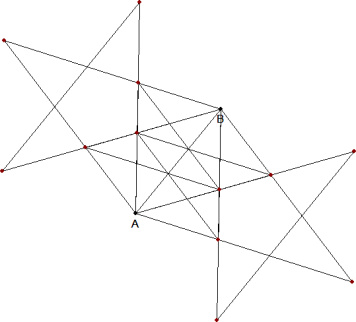 Any point at a distance from one of these 12 points smaller than a tolerance value E can be considered "on a pentacle" defined by the two points A and B. Please, download the complete R file from here: pentacle.txt Using these formulas, a function aligned can be defined to verify if the point (C1,C2) is on a vertex of a pentacle defined by points (A1,A2) and (B1,B2). The function can be downloaded from here: pentacle_aligned.txt This function recognises as "aligned" to A&B-generated-pentacles all the points inside the yellow circular areas, each of which has a radius equal to E: 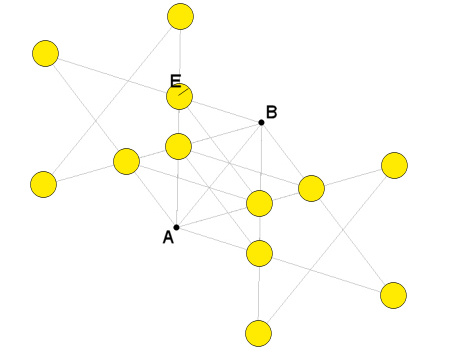 By using this function on Rennes-le-Château map and selecting La Tour Magdala and the Château de Blanchefort, with a tolerance of 400 meters (!) you can identify a unique point fitting one pentacle, the Bezu Chapel: 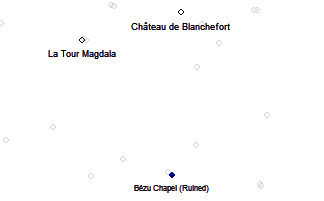 RelevanceHas a result like the one mentioned any relevance? In order to prove it, you should compare the number of alignments found in a particular map with the mean number of alignments found in a large set of RGMs (randomly generated maps): "chi square" analysis will show if the map you are considering has any (sacred?!) "relevance". By now all the studies failed to show that there's any relevance in Rennes-le-Château area, but any analysis which pretends to affirm it has to follow the steps provided in this short guide. © Mariano Tomatis Antoniono |